Prion Resistance
Started: 2026-08-13
Published: 2026-08-20
Prions feel like the boogeyman of the science world. It defies the central dogma where a protein is responsible for become "mutated" instead of the cell cycle messing up Transcription from DNA to RNA or Translation from RNA to Proteins. Lots of places to mess up when you are copying and pasting! Transmitting disease after this protein is already made is thought to be rare, but may be more common overtime as researchers test more hypotheses.
Prions as a word can mean the prion protein, the prion disease, and the prion protein phenomenon which is a terrible situation for news reporting and lay people doing research. I’m going to briefly clarify and then move onto my main interest of prion disease handling.
What is a prion protein?
- Normal prions are proteins in the brain that can be found in a TON of animals.
- Research suggests that the prions collect up copper ions and may regulate NMDA receptors. These receptors help control ion channels like moving Ca+ across different membranes.
- The mechanism is that without the protein, NO reacts with Cu+ ions and cysteine thiols to S-Nitrolyze a glutamate to bind to the receptors it allows the receptors to open. With Prions there, the Cu+ is soaked up and cannot create the reaction between NO and the cysteine thiols so it deactivates the NMDA receptors.
- Prions also show that they react to NCAMs and tyrosine kinase Fyn to promote neurotigenesis. Protein kinase interactions were also seen in the hippocampus.
- https://pmc.ncbi.nlm.nih.gov/articles/PMC5578479/
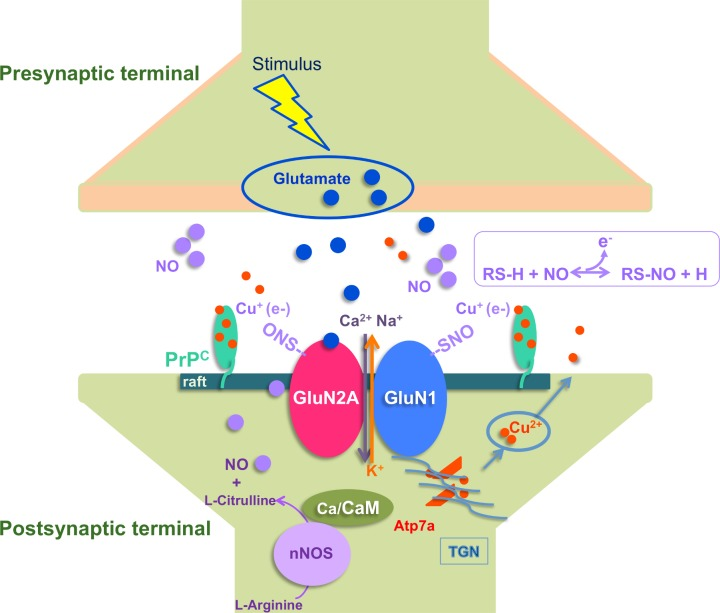
- Prion coding region located within one exon so no alternative splicing concerns.
- The gene for prions were knocked out in mice and researchers found that the white fat around the neurons to help transmit signals faster, myelin, ended up degenerating faster as mice aged than normal mice with prions.
- This is why so many prion disease symptoms are related to the brain degenerating.
What is a Prion Disease?
- Prion Disease is spread by misfolded prion proteins in the brain and other tissue. The misfolded prion ends up being more dense and has an hydrophobic handshake sticking out to other nearby prions. If a normal prion grasps this hand, the normal prion is pulled into a misfolded shape and they now stick together. This aggregation does not undergo the normal cell cycle with protease degradation in the brain so it ends up being fatal. The prion proteins do not get refolded because it takes less energy to be misfolded. And I personally think that there have not been enough evolution and checks to fix a prion specifically because it would not have been common enough to evolve for.
- Prion disease can happen spontaneously, there was around 150 cases reported world wide so very low chance. Or it can happen by eating disease infected tissue.
- Prion disease in animals mainly affect ungulate animals, mainly because humans raise so many to eat. Ungulates are specifically the sheep, goats, cows that have caused the biggest stir. The disease of the animal is named after the symptoms that manifest.
- As hinted, eating an infected cow has led to people to develop prion disease as well. The infected cow started from infected sheep and goat being processed into blood meal and fed to cows. Contrary to what people believe, herbivores do eat meat even if most of their diet comes from plants. They’ll supplement their diet opportunistically with meat so while feeding a cow meet sounds weird, cows will eat animals for the nutrients.
- Grain feed is used in the UK and Wales but still have high counts of Prion Disease as well. There were 178 cases in the UK and 54 reported worldwide according to this 2021 paper in the past 25 years, the next most prominent is France with 28 cases.
- BSE in UK may be caused by lipopolysaccharide bacterial endo toxin found in grain
- Issue is England and Wales do not use hexane to remove endotoxins from their grain but Scotland does and has lower incidence of “BSE”
- LPS injections into mice led to 40% of trial subjects developing BSE symptoms.
Diseases associated with prion misfolding
- Kuru - Papua New Guinea tribe members underwent transumption, consuming dead relatives to respect and mourn them. Kuru matches Sporadic Creutzfeldt-Jakob diseases. One person likely had it and spread it through the population from transumption. As they died and people partook in more transumption, the sicker the population got.
- The Fore tribes had gender imbalances because women and children were disproportionally affected by kuru because they ate the brain tissue and organs of the deceased. Men traditionally ate the muscle tissue that do not get infected by kuru prions.
- Dr. Alpers was the researcher on the forefront of Kuru medical anthropology who had a theory that cannibalism was a lot more prevalent than previously believed because of the various genetic adaptations to defend against disease transmission from eating another person. His lab has released many papers on it.
- Scrapie in Sheep and Goats
- Scrapies symptoms were well known in farming for a long time, even if they did not understand the root cause. When sheep have misfolded proteins, they end up scraping up against fencing and other barriers to create open lesions on their skin. Apparently prions causes itchy skin.
- The prion degeneration compounded with infections from open wounds lead to poor health of the sheep and quick degradation.
- It is also a fatal neurological disease and has been observed since approximately 1693.
- Scrapie is apparently not as compatible with human prions as there has been no reported transmission in the past 300 years.
- One interesting theory is that China may have seen scrapie since 1000 BC based on character composition.
- Bovine Encephalitis in Cows
- BSE is also known as mad cow disease, it describes the behaviors of cows when they were impacted by misfolded prions. They were more agitated and led to the name.
- As mentioned before, the blood meal from sheep were fed to cows as a cheap nutrient and infected the cows with BSE. Cows infected with BSE are more likely to pass it on to humans, dogs and cats because of their protein shape.
- Variant Creutzfeldt-Jakob disease (strain of prions that causes BSE)
- When a human comes in contact with BSE from cows, there is a chance that they end up developing variant CJ disease.
- It seems to be transmitted through injection the most as there have been low risk of transmission through blood transfusion but the authors admit that the window of time was short given that CJ disease can develop over decades.
- Fatal Familial Insomnia
- The prions in the brain aggregate in the thalamus to disrupt sleep, memory, and ultimately death from being unable to sleep. People do not live past 18 months after diagnosis given that people were so confident that they named the disease Fatal.
- It was determined to be a prion disease variant through genetic testing. The earliest known case was believed to be an Italian family from the 1700s.
- It is inherited in an autosomal dominant manner.
- Gerstmann-Straussler-Scheinker syndrome (GSS)
- Prions misfold and eventually develop into dementia and being unable to control motor functions. It is caused by a variant of the prion gene - this is also inherited as an autosomal dominant manner.
- Chronic Wasting Disease
- Forest ungulates like deer, elk, and moose are all impacted by CWD prion shapes. They are conserved in the fecal matter of injected deer, which can be taken up plants and spread through vegetative propagation.
- The name of this disease comes from the deer being a husk of itself with a skeletal structure and an inability to meet its basic needs.
- There have been no accepted case of CWD spreading to humans even though there may be circumstantial evidence. Two huntersdeveloped CJ disease and died shortly one after the other. People were not impressed by the scientific rigor ie not genotyping the people who died, not testing the deer meat they were supposedly infected from, and not testing the deer herd for protein similarities.
- There are papers that support eating Venison with CWD will lead to CJD as well but there are other papers that are likely to say it was unrelated to being a hunter and eating meat.
- Not confirmed but highly likely
- My pet conspiracy is that hunting brings in such lucrative licenses, the lobbyists suppress this news to not scare people since odds of infection are low.
- Camel Brain Encephalitis
- Camels are pack animal ungulates bred for their usefulness and maybe sometimes for their meat. In any case, one paper from 2016 stated that the had no known case of prions in camelids.
- Unfortunately published just two years later, a report of prions in camels and dromedaries was made. The year the first paper came out, the researchers said that 3.1% of dromedaries had prion misfolding disease, so it’s not like it didn’t exist but apparently people were not looking.

- Protein Prion Phenomenon
- Ever since prions were discovered, people realized the protein aggregation is a viable disease.
- Parkinson's Disease is believed to be caused by protein aggregates of amyloid proteins.
- Huntingtons is the accumulation of long glutamine chains
- Cystic Fibrosis is the accumulation of CFTR proteins that make a sticky mass in the lungs.
- Ever since prions were discovered, people realized the protein aggregation is a viable disease.
- Lots of scientists also challenge the infectivity of prions by forcing prions and testing if it infects other creatures based on proximity. Interesting pre-planning but there are so many suppositions that have to take place.
- If pigs were infectious with prions, they could infect humans.
- Ducks may be susceptible to prions where chickens do not.
Combatting Prion Disease
- Genetically, prion diseases are based on the proteins being susceptible to misfolding so if you happened to have a herd of animals, they can be selectively bred for resistance.
- For scrapie, the USDA put together an informational guide about resistant genotypes. They explain that Codeon 171 of the prion gene is one of the most important regions and that codon 134 may play a part in resistance as well. There is no recombination since the codons are so close together.
- The most resistant genotype was Alanine/Alanine and Arginine/Arginine which makes a lot of sense because alanine is one of the most basic amino acids, it only has a carbon side chain. It is very stable. Arginine has a carbon chain and the side chain ends with three nitrogen groups that have a resonant double bond. That thing is a strong sucker!
- The most susceptible was Glutamine/Glutamine in any codon spot because of the polar aldehyde side chain. Definitely the main culprit on why sheep are susceptible!
- A similar trend is seen in deer where glutamine to serine configurations have led to resistance to CWD but not complete immunity. This is likely because serine also has a polar side chain but it is more protected with the carboxyl group allowing for double bond resonance. Glutamine does not have the same stability. The deer likely do not have complete resistance due to the polar side chain and it would be better if there were more neutral amino acids in its place instead.
- The prevalence of the serine amino acid in the critical spot is hypothesized to be selective breeding by deer farms driven by disease selection.
- Selectively breeding for resistance comes with draw backs, these configurations apparently lead to more chances of infections with a weaker species barrier.
- Proteases allegedly do not affect diseased prions but lichen studies have shown that serine protease degrade misfolded prions effectively in a few specific species: Pamelia sulcata, Cladonia rangifernia, and Lobaria pulmonaria. Species from the same genera did not have the same effectiveness.
- A theory the authors had was that the fungal symbiont is able to contribute to the effectiveness of prion degradation through synergistic chemical reactions.
- The authors believe that the proteases that target prions are a defense mechanism against fungal infections.
- Yes there are fungal prions!
- One paper tested the efficacy of multiple Lichen around the USA against prion diseases. It seems that species is the dependent factor and not where the lichen was found.
- Typical ways to decontaminate tools of diseased prions was to soak in bleach (NaOCl) for at least 1.5 h and autoclave it at 125C.
- Bleach helped reduce prions to undetectable levels but it still contained infectious prions.
- This is an issue as the instruments need to be rinsed or the bleach fumes can damage the health of people who clean these instruments and the autoclaves.
- Enzymatic cocktails that are commercially available also seem to work just fine - 20 min soak at a pH of 10-11 did fine.
- Carnivores seem to be resistant to prions specifically against chronic wasting disease.
- I literally tried googling "carnivore name" and "prions" to see if they get negatively impacted by prions and they usually don't!
- They accumulate the prions in their bodies and scientists aren't too sure what happens next. They definitely defecate infectious proteins (coyotes, cougars/mountain lions, crows) and translocate them, but they sequester quite a lot in their lymph nodes and other tissue.
- Bob cats seem to be the most effective at digesting proteins as there was only 3% of infectious prions in the fecal matter compared to what the scientists fed to them.