A. Spandrels of Biology
2026-08-22
August 2026's IndieWeb Carnival is hosted by Chris to discuss the concept of "purpose". I wanted to talk about spandrels in biology but first I will back up to talk about what led to the spandrel analogy and plant biology.
Natural Selection is the theory where every living thing is the product of their ancestors outliving whatever life hurdles were thrown at them to pass their genes onto the group that is currently living. Biology is often simplified to be able to explain things quickly. This can lead to the high level thinking that every feature evolved for a driven reason, but lots of changes are from by-products.
Charles Darwin that popularized his theory after he examined "finch" birds he collected as souvenirs. He found that different islands had different beak sizes depending on what food niche they filled. Longer peaks were better at maneuvering seeds out of spiked pods while round clamped beaks could break onto hard shells more effectively. If you were interested in purposeful selective research about these birds, I would recommend Beak of the Finch by Jonathan Weiner that looks at the Grant Lab's 30+ years of research.
Darwin also theorized that for every flower shape, there is a pollinator that fits it in a process called co-evolution. He was inspired by the Christmas Orchid (Angraceum sesquipadele) that had it's nectar stores 20-35 cm inside it's spur. A flower that does not have a pollinator, is a flower that does not survive. Most pollinators would be deterred, if the nectar is so difficult to get, there is no point in visiting them. Thus, its pollen doesn't spread to other flowers like it and seeds are not formed to grow the next generation. As such, Darwin guessed correctly because 20 years after his death, the Morgan Sphinx Moth (Xanthopan morganii) was discovered with its 20 cm probiscis. We see this pollination co-evolution also in hummingbirds with curved bills to match curved flowers nearly exactly. But is everything settled perfectly like that?
Lewontin and Gould repelled the idea that all biological properties had a selective purpose and may just be by-products in their critical paper published in 1979. Some people did NOT like this idea (and some people still do not like it) so Gould wrote another paper clarifying the idea. Gould specifies that a spandrel is any space that is shaped the way it is because of a different main vision. For his example of San Marco's Basilica in Venice, the architects wanted a large dome roof on a set of round arches, so you are going to get spaces that you need to fill in which are denoted as spandrels (critiques would quip that these spaces are actually pendentives).
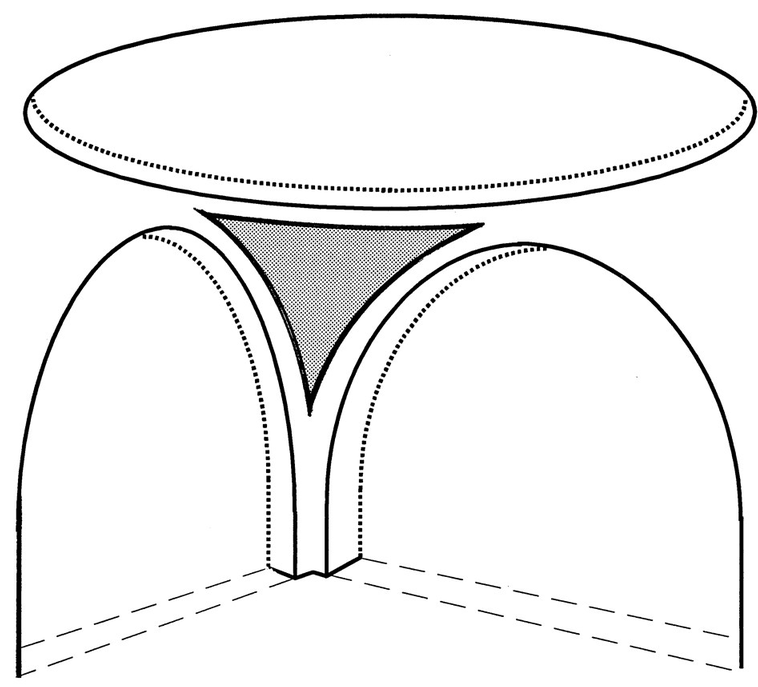
Figure 1 of Gould's 1997 paper. Depicts the concept of a spandrel as Gould imagined it in dark grey as a result of two archways coming together to support the dome top.
These areas later became areas that were great for decoration as a by-product of the primary architectural goals. When we put it into a biological context, it is too easy to point to a feature and make up a reason why that feature is so important to the development of an organism. It is okay to say "I don't know why this exists" which is a great way to start the search for answers and "research"! A spandrel was not specifically made because it is a great decorative element, that purpose came after the architects decided on this shape.
Adaptationist thinking is a detriment to molecular evolutionary biology, which is the study of small molecules like proteins and why they have the function they do. Even more niche, I studied plant biochemistry in a lab where they researched how plants make medications important to humans. We can map out how western sciences thought of these plant molecules based on their definitions. Primary plant metabolites are molecules that are critical to plant functions, while secondary plant metabolites were considered by-products of plant metabolism. The recent terminology has shifted to "specialized metabolites" to specify that they can help a plant survive in adverse conditions, but it doesn't change the fact that they developed as a result of primary metabolites. Enzymes are like little assembly machines that stick on chemical decorations onto a backbone molecule. They would have initially evolved to make primary metabolites but could be co-opted to make secondary metabolites.
Specialized metabolites important to humans that you might drink every day is caffeine. A plant does not make caffeine out of pocket to increase human productivity, it doesn't even have the goal as a purported insect deterrent. How would a plant "know" it can stop insects until they make it out of chance and suddenly it gets eaten less? Scientists looked at the development of Caffeine in citrus plants by comparing genes to other species in its genera that do not make caffeine and they found that it only needed two mutations to change the enzyme function called XMT (Xanthine Methyltransferase aka add a carbon branch to a Xanthine molecule) to make caffeine. According to the authors, that Xanthine enzyme was co-opted from the production of salicylic acid, the natural inspiration for aspirin!
It's just easy to make caffeine and that's why it exists in so many plants, not because it was the primary goal of the plant to make it, but it's helpful nonetheless. To connect it back to the analogy, enzymes are the arches to support the dome of the plant making primary metabolites to live, but the enzymes can make Caffeine and other specialized metabolites just out of chance which fill in the gaps as spandrels. There are over 200,000 specialized metabolites out there because enzymes are so vast and can decorate molecules in multiple different ways.
Evolutionary purposes can be driven in a form of survival and helpful (perceived) mutual benefits between two species, or purpose might just come up as a happenstance because it is easy to make and the benefits aren't known until later. To co-opt a different August submission, purpose can come after the thing exists.
Do you have any spandrels that you've seen in your life? Are there any functions you've noticed in plants and animals that you want to research more into?