A. Museum Reflections - Canadian Artists March 2026
2026-03-07
I utterly love museums (art galleries), there is just so much sheer talent and passion packed within the walls of people who can create things from their minds. I previously reflected on my visit to the Vatican on my favourite art piece, Gallery of Candelabras Frescos by Ludovico Seitz, but for this IndieWeb Carnival hosted by James , I decided to write about my July 2024 visit to the Winnipeg Art Gallery.
I travelled to Winnipeg for a Science conference and had a great time! I met temporary friends, but great company nonetheless. We spent the last day together at the Winnipeg Art Gallery (WAG-Qaumajuq). They were pressed for time so I went around to locations that they wanted to visit.
The most important part of an art gallery for me is context. Why was this piece created, what was the artist's inspirations, what part of their history informed the art?
Inuit Art
There were many delightful galleries. The WAG-Qaumajuq is home to the largest collection of Inuit art pieces in Canada. Qaumajuq (pronounced KOW-ma-yourk) means "it is lit, it is bright" in Inuktitut.
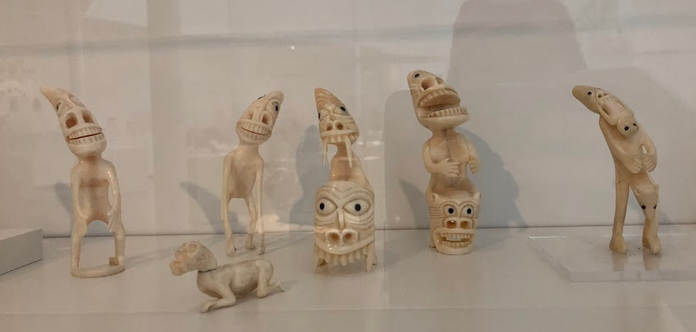
And it is bright! The main gallery has white walls and white stone to match the bone carvings seen on display. One of my favourite sets of carvings were the tupilak made by angakkloq (shaman) from Kalaallit Greenlandic Inuit communities. They are grotesque and dangerous creatures made to kill enemies. It is very interesting to me that they were chosen to be put on display despite their abominable status. According to the art guide, the carvings were made of dead animals, sinew (preferable a child's??), moss and or seaweed. The angakkuq gave them life force which means if the target is more powerful, the tupilak would turn around to kill their maker.
Modern Inuit carvers no longer imbue the carvings with killing intent, but they made facsimiles using whale teeth, walrus tusks, and caribou antlers. That's why the ones in the gallery have such a distinctive slant to them.
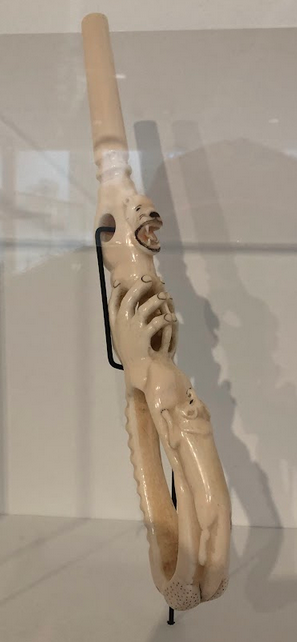
Another piece I enjoyed was the intricacy of the bone flute carving. It is stunning to see the fine carving of the hand gaps and even subtle knuckle bone details.
Another sub collection that I thought was interesting was Omalluq by Omalluq Oshutsiaq. When I first saw the art pieces, I was a bit confused because it didn't seem to fit with the rest of the carvings, mainly because these were coloured pencil drawings that seemed pretty juvenile in skill. I started at the end of the gallery and walked forward since there were two openings. Oh my god, when I got to the front with the plaque, it was a depiction of Oshutsiaq's life that she drew two years before her death. She was a talented stone carver throughout her life but tragically had an accident with an electric carver and lost function of her hands. The coloured pencil drawings are an artist's return to art after losing her main mode of creation AND relearning how to reuse her hands to create. She kept creating until the end. I know people say art is whatever you seen and make of it, but I think the history behind it informs so much.
Winyan by Lita Fontaine
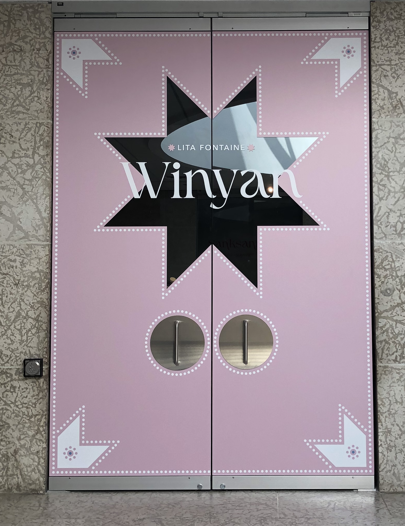
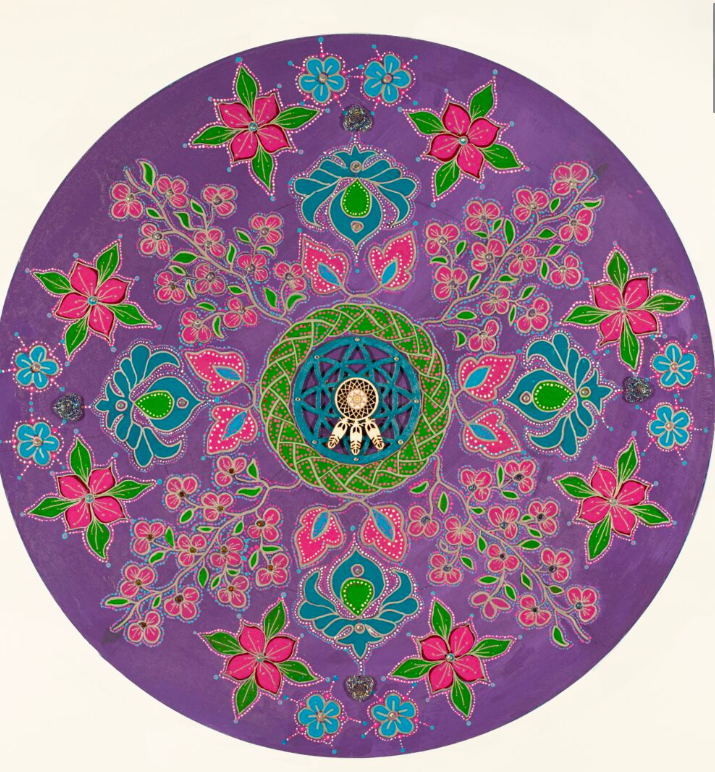
The gallery that my conference buddy was excited about was Lita Fontaine's Winyan exhibit. It was extremely warm and welcoming with these pink doors. As a Dakota/Anishinaabe/Metis artist, she focused on Indigenous femininity to put them in the forefront of the art gallery. There were lots of beautiful floral motifs in mandela creations that were humungous. The one seen below is Purple Sweetgrass, a symbol of reciprocity and interlocking companionship. Fontaine also had numerous dresses on display, real and fake. The one that I still remember was a painting of a dress with red flowers along its hems.
One motif that I found interesting was of the Sky Woman. She is a sky goddess who became pregnant and well down to earth. A turtle rose up to catch her and with the help of other sea animals, the land was raised for her to safely live on. I knew that some Canadian Indigenous cultures called North America Turtle Island. The tidbit I got was because North America looks like a turtle, but I think it is way cooler that the name is connected to a creation myth. It is Turtle Island because it was the first animal (but not last animal) to show kindness to humans and created a shared land.
Jean Paul Riopelle
Okay everything was warm and bright until my friend and I got to this gallery. I even remember telling my friend to skip this gallery because of the heebie jeebies I got just standing in the doorway. It was entirely monochrome with very repelling edges sculptures. We walked to Wiyan first for this reason! My friend left to catch her flight but I wasn't in a rush and circled the entire museum. Eventually I was confronted with Riopelle's exhibit and I thought I would have a quick walk through.
I don't know how to describe it, it felt cold and eerie to walk through his gallery, like something was going to jump out at me. Why was Jackson Polluck adjacent art scaring me? I don't know, maybe it was the lack of colour. The ivory carvings had more warmth and tone than the entrance to Riopelle's exhibit. Was it purposeful? Whose to say, but he is apparently one of Canada's most famous artists and this gallery was to pay homage to him as he had over 6000 different art pieces across many different types of media. He painted with car enamel on cardboard at one point because it was cheap and he wanted to keep creating. But oh, I'm so glad I kept walking through the exhibit!
The fear of silence transformed into serenity when there were suddenly snapshots of life captured in water colour. I loved how they are suspended and swayed freely with light refracting from the mirrors to break up the monotony. There was even a big green armchair to invite someone to sit down and just reflect the piece more. And I did!
Based on his wikipedia page, Riopelle retired to the l'Île-aux-Grues (Island of Cranes) to ironically study geese and my guess is that is when he painted all of these water colours. He ended up being obsessed with geese later in life and it became the main subject of his paintings until his death. I don't think I saw any geese paintings in the gallery, but I can appreciate a person who makes a singular bird his entire personality.
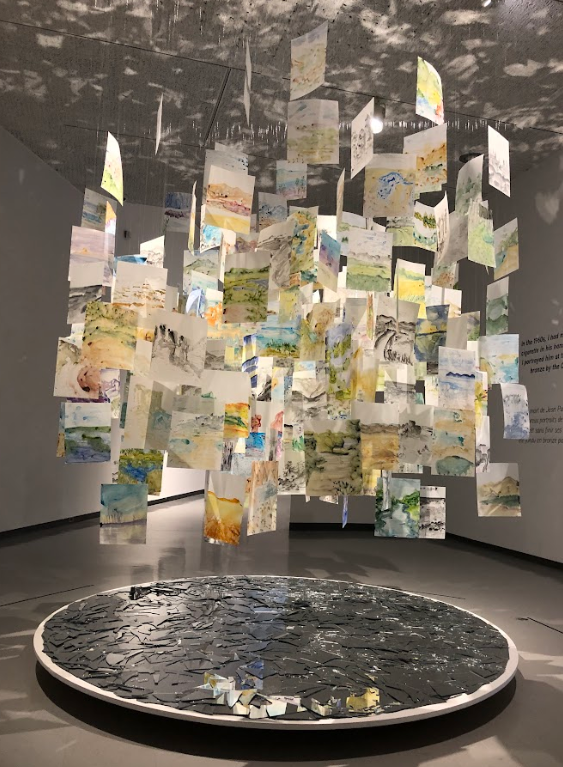
"It is lit, It is bright"